Search This Site

Spread Trader Pro

Michael Bigger is an investor and a trader who has been involved with trading technologies for more than twenty years. In 1992, Michael joined Citibank as head trader of U.S. single-stock derivatives, where he managed a $5 billion portfolio of equity derivatives. In 1998, he joined D.E. Shaw & Co., L.P. to trade the U.S. equity derivatives portfolio. (More)

Creative Flow

In Praise of Speculation

This form does not yet contain any fields.


    Wednesday
    May302012

    How to Rate Spreads

    For traders of equity spreads, one of the biggest challenges is finding quality spreads to trade.  In our webinars, one of the most common questions is how to find good spreads.  
    Of course, one way to find good spreads is to sort your SpreadTraderPro daily scan by the characteristics that you find most interesting.  But this can be time-consuming.  That is why we are developing a database of highly rated spreads.  
    Here is how it works:
    -you rate 10 spreads per month (instructional video below)
    -we compile the data and sort it
    -you will be able to see the highest rated spreads
    It is pretty simple.  It is the next wave of technology to help spread traders make more money.  And it is coming soon.  So get started rating spreads today!


    Written by Jennifer Galperin. Follow me on Twitter and on StockTwits 

    Thursday
    May172012

    Parameters of Statistical Arbitrage Spread Trading  Webinar

    This past Wednesday we held a webinar about the parameters for statistical arbitrage spread trading. We had a great audience, and many people have written me separately to ask about a replay.  You can find the replay at the bottom of this blog post.  

    One thing that always surprises me about spread trading is how many different ways there are to look at it.  Even within statistical arbitrage, you might think that computers can choose the spreads and trade the strategy without human input.  But the old saying "garbage in, garbage out" holds true here too.  The trader has to design a strategy to select spreads based on the parameters.  There can be as many different strategies as there are traders, because each trader takes a slightly different view on the input parameters.

    In the webinar, we talked about the significance of cointegration, half-life, zscore, and term.  I talked a little bit about how my strategy views these parameters, and I am interested to hear how your strategy is designed.  Please feel free to comment about that, or leave feedback about the webinar.  

    Here is the webinar replay:


    We hope you will join us next month for the next webinar in the series.


    Written by Jennifer Galperin. Follow me on Twitter and on StockTwits 

    Wednesday
    Apr252012

    I Wish I Had Learned to Trade This First

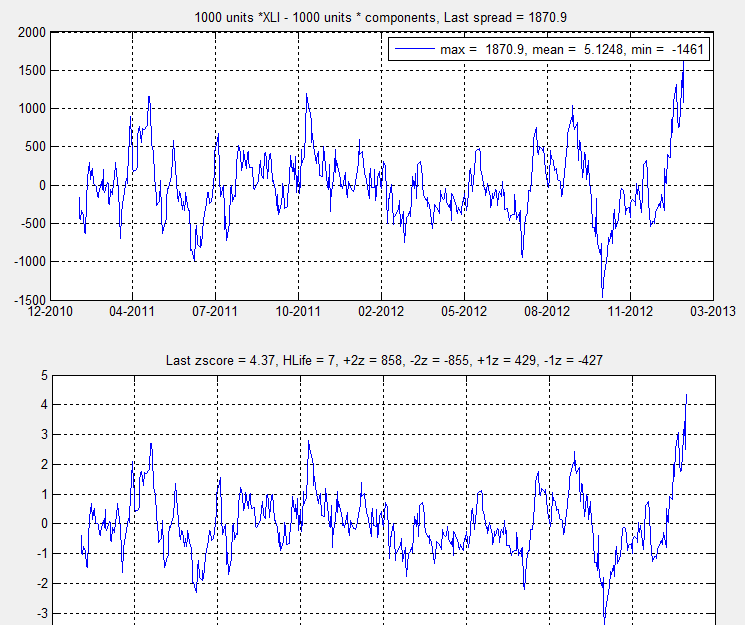
    A while ago I wrote a blog post about Starting Over. There are a lot of things I wish I had known when I started my trading career.  One thing I wish I had done was to learn how to trade 8*$SPY - 13*$IWM. This is my favorite trading vehicle. I think most traders should keep this spread on their screens.  The trading apprentice should play with it in a sandbox. Here is the statistical run-down on it:

    For a larger image, click here.


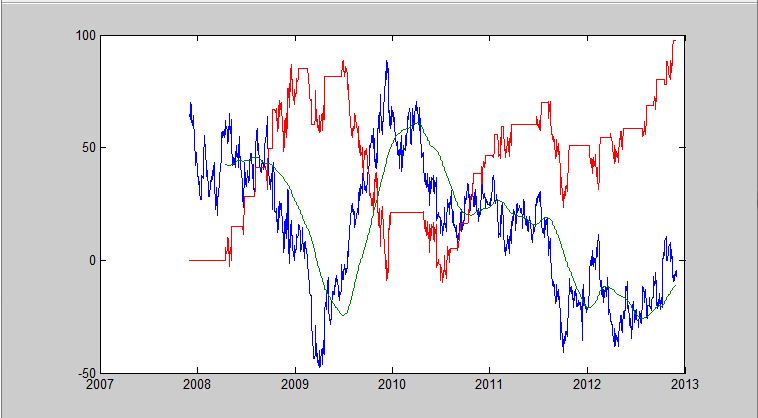
    Here is a graph of this spreads at a shorter time scale:

    If you want to become a professional trader, there is a lot to learn.  When you are first starting out, SPY-IWM is a great product because it is liquid, easy to understand, can be traded on a short (but not instant) time-frame, and provides lots of opportunities to make money. It will help you learn some of the subtle yet important aspects of trading, such as:   

    • Setting probabilistic and symmetrical stop losses 
    • Emotion and it's impact on the market
    • Liquidity gaps and spikes
    • Pricing lags in one security versus another
    • Changes in the market environment, and how to adapt your strategy
    • Intraday time windows

    What is your favorite trading vehicle?


    Written by Michael Bigger. Follow me on Twitter and StockTwits.

    Friday
    Apr202012

    How to Build a Spread Trading Playbook

    In this video, Jennifer also reveals how I trade my Favorite Spread: 8 * $SPY - 13 * $IWM.

    .

    Monday
    Apr022012

    Darwin the Trader

    Charles Darwin is widely known as the man behind the Theory of Evolution.  He theorized that through evolution a species could adapt to different environmental conditions.  Those individuals who did not adapt would not survive to pass along their genes. 

    A friend said to me the other day, “It is the market’s fault I lost money trading last month.”  

    I could have agreed with my friend's opinion since I have spent the last two years building my quantitative strategy and I have had plenty of setbacks along the way. Now in the current low-volatility enviromnent I am making money trading my strategy at a very short time scale, choosing my entry points very wisely, and capitalizing on many small gains.

    At various points in my journey so far, I have had to cut limbs to survive. I had to admit I did not know much about quant strategies when I started. I made mistakes, took steps back to think, I iterated, re-tested, and moved forward. I had to adapt to market conditions all the time. 

    What has worked for me is to adapt to different market conditions all the time.  Like a football team, I started by building a book of plays that will work at diffeSave & Closerent times and against different opponents, in different market environments. I learned that what worked last week may not work this week or next.  I need to understand my opponent by recognizing trends, inflection points, and themes in the market, all of which can change on a dime.  I use my growing playbook to exploit this situation.  If you build a good playbook you will have the trades set to make money in any market conditions by adapting and evolving.

    A playbook is the tool I have built in order to adapt. 

    So how do we adapt?  For quantitative traders, this can be one of the hardest things to do.  Computers don’t learn and adapt, they just crunch numbers.  Humans need to think very carefully about the inputs.  Maybe that means we ask the computer to look at performance of the strategy in bull and in bear markets, or in low and high volatility environments, or in times when oil prices are low and high.  Whatever we think might impact our strategy.  Maybe we find that when certain market conditions are in effect, we need to tweak our strategy (or radically change it).  Then, experiment with the change.  Try one or two small trades to see how they perform.  But don’t get too comfortable, because the next change in the market is just around the corner.  

    Later this month, I will host a webinar discussing how I have built my playbook with detailed trades. Stay tuned ... details to come shortly.

    Written by Jennifer Galperin. Follow me on Twitter and StockTwits.

    Thursday
    Mar152012

    Learn to Trade Like a Math Geek

    On Wednesday we held a webinar "Learn to Trade Like a Math Geek". We had great turnout, and I want to thank everyone who joined us. I've received a lot of emails asking about the recording, which you can find at the bottom of this blog post. We discussed some of the key math terms involved in statistical arbitrage spread trading. Many of the questions were specifically about calculations and how they are done. It is important not to get too bogged down with the math. Cointegration tells you that the two stocks have a history of reverting to a mean level like a spring. When you design your statistical arbitrage trading framework, you want to build a portfolio of these spreads. You should see that most of them behave nicely, while a few continue on their trend away from the mean. You'll develop your own recipes for determining when spreads will behave well and when they will not. You may even develop some recipes for trading spreads that are very different, like the earnings strategy we discussed at the end. The beauty of statistical arbitrage spread trading is that you can design your own strategy however you find it works best. Here is the replay.


    Written by Jennifer Galperin. Follow me on Twitter and StockTwits.

    Tuesday
    Mar132012

    Learn to Trade Like a Math Geek Webinar

    We are doing a webinar tomorrow called "Learn to Trade Like a Math Geek". It will be at 4:30pm eastern daylight time. We will discuss the mathematical side of statistical arbitrage trading in a very practical way, no knowledge of statistics assumed. Please click here to register.

    Monday
    Mar122012

    Volatility Traders: a Great Tool for You

    My main trading strategy is long/short equity pairs based on statistical methods so our web based Spread Analyzer is an essential tool for me.  But even if your strategy is not based on statistical relationships our Spread Analyzer can also add value.

    In addition to my long/short strategy I also trade options, and I’ve recently gotten in the habit of using our Spread Analyzer for that strategy too.  The strategy involves buying cheap volatility so there is no direct connection to statistical arbitrage.  Yet I find it’s useful to see how over or under valued a stock may be relative to the market or its peers, and how strong that statistical relationship is.  For example, if I think volatility is beginning to look cheap in a particular stock but I can’t decide whether to buy or wait, I’ll run the stock through the Analyzer against the market or its peers.  If the stock looks expensive (with a strong statistical relationship) I will probably buy volatility.  If it looks cheap I might decide to wait.

    Whatever your strategy, there are probably dozens of ways the Spread Analyzer can be a useful tool.  It only takes a few seconds.  Try it and let me know what you think.

    Written by Norm Winer.  Follow me on Twitter and StockTwits.

    Wednesday
    Mar072012

    Migrating to the Cloud

    Fred Wilson wrote a great post about moving from Skype to Google Hangouts. You can read his post here.

    What really caught my attention in this post was the following statement:

    But my decision last year to leave the world of files and apps and get to the cloud has been incredibly liberating

    That statement resonates with me because I find it liberating to run web enabled applications. This is the main reason we developed our web-enabled Spread Analyzer. It was a pain in the ass to upgrade our own internal software on each trader's desktop. So we decided to change our approach. It was liberating. Once we enabled our tool, it became obvious to us that other traders could use it as well and the incremental cost to allow others to use it was minimal. So we opened it up with minimal friction, and it opened up all kinds of avenues for us to explore.

    Fred Wilson is a very successful investor and his statement speaks to the paradigm shift currently under way in technology. Big money with big stocks will be made on this shift.

    I am paying attention. You? 

    Written by Michael Bigger. Follow me on Twitter and StockTwits. 

    Monday
    Mar052012

    Magical Widget

    In a frictionless, costless, and magical world, I would have a magical widget that allows me to interact with financial data in the following fashion.

    From any program I could make a call resembling this:

    Get (ticker A, market capitalization, source of information) =====> output = accurate theoretical market capitalization for ticker  A

    I could use this widget to run algorithms in spreadsheets, program scripts, and so forth.  I could search for companies trading well below (or above) their theoretical market capitalization and make lots of money.

    My goal is to find or develop this tool in the real world.

    GoogleFinance's structure most closely resembles what I am looking for but the set of attributes is very small. It is a start though, and a window into the future. 

    In the meantime, information gatekeeping and speed bumping will continue to be a very good business.

    Maybe Amazon.com's Mechanical Turks can be used to bypass the gatekeepers. Perhaps also the Twitter API.

    Do you know of any cool financial tools that can get me closer to my goal? Is my magical widget something you would use if it existed?

    Would this be something useful?

    Get (AAPL, AMZN cointegration 5yrs, Bigger Capital) =====> cointegration of AAPL and AMZN over a 5 year period


    Written by Michael Bigger. Follow me on Twitter and StockTwits.